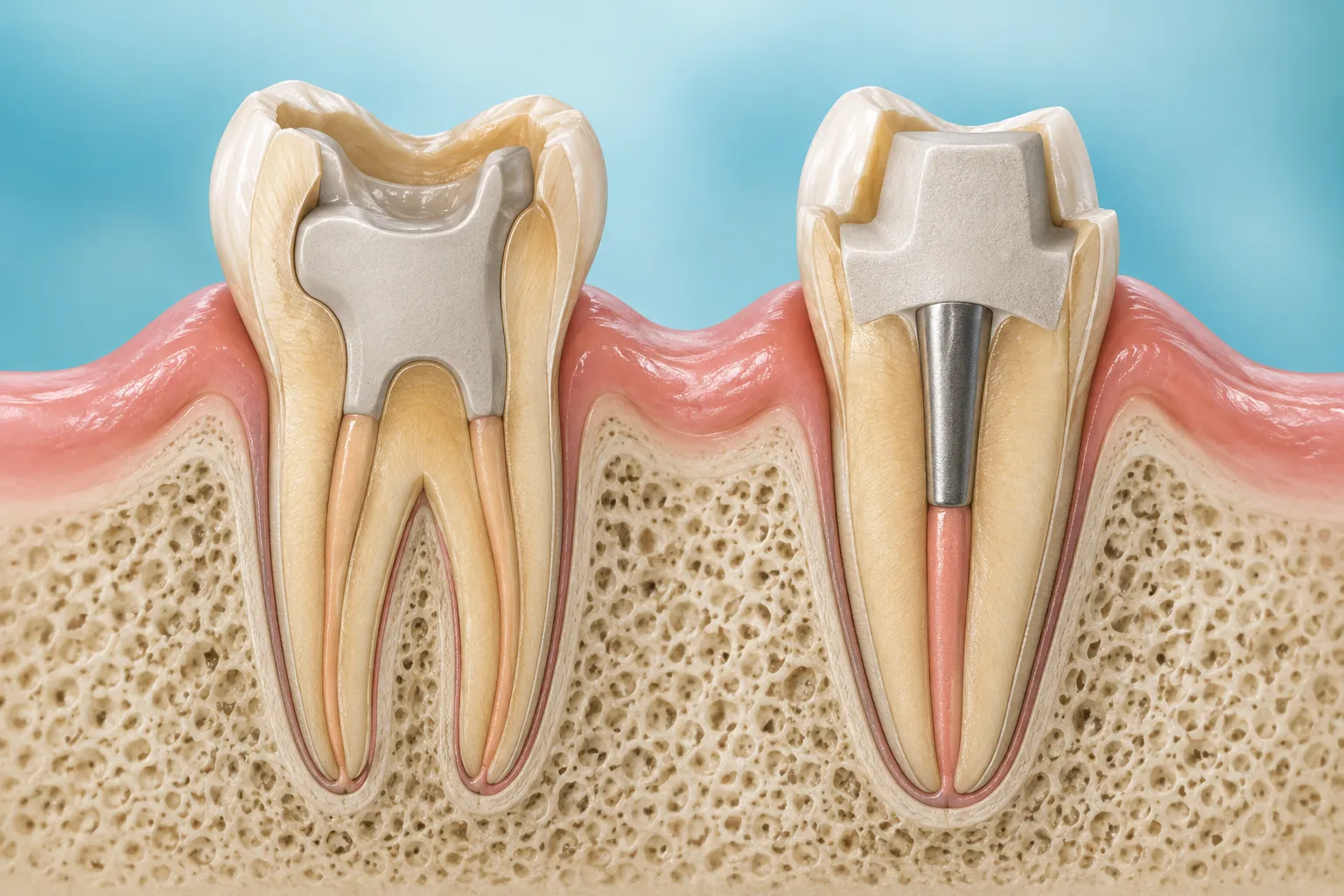
What is a tooth core build-up?
The core is the supporting part of a tooth above the gum. When decay, a fracture, an old restoration or access for root canal treatment has removed much of this tissue, the dentist may rebuild the core to create a stable shape for a future crown.
A core build-up is a separate treatment stage from making the crown. Whether it is possible and which method is appropriate can be decided only after examination and diagnosis.
What is a dental post?
A post is a retention element placed into part of a prepared, root-filled canal when the remaining coronal tissues cannot retain the build-up by themselves. Restorative material is then used around the post to form the core.
The post does not treat infection, replace the root or automatically make the root stronger. Preparing space for it also removes some root dentine, so it should be used only when clinically justified.
What is a custom cast post-and-core?
A custom cast post-and-core is made as one fitted construction: its intraradicular part enters the prepared canal and its coronal part forms the core for the crown. It differs from a prefabricated post surrounded by a separately placed core material.
Neither option is universally better. The choice depends on the individual tooth and the planned restoration.
Post or custom post-and-core: what is the difference?
With a prefabricated post, the dentist selects and places a ready-made post and builds the core around it. A custom cast post-and-core is fabricated to the prepared anatomy as a single unit.
The dentist considers the amount and position of sound tooth tissue, root condition, quality of root canal treatment, canal anatomy, future biting load, planned crown type, possible cracks and whether a reliable foundation can be created. These factors matter more than a universal label of “better”.
Can a crown be placed on a post?
In everyday speech, patients often say “a crown on a post”. More precisely, the crown is placed over the rebuilt tooth core; when needed, a post or a custom post-and-core helps retain that foundation.
The core build-up and the crown are separate treatment stages and are priced separately.
When may a post not be needed?
If enough well-positioned sound tooth tissue remains to retain the restoration, the dentist may choose a core build-up or another restoration without an intraradicular post. Root canal treatment alone does not mean that every tooth requires a post or a crown.
Why the remaining tooth tissue matters
The prognosis depends greatly on how much healthy tooth remains and where it is located. If the future crown can encircle a stable band of sound tooth tissue above its margin, this “ferrule effect” can help the tooth-restoration complex resist functional forces.
A post cannot compensate for every loss of tissue or an unfavourable root. The dentist therefore evaluates restorability as a whole, rather than deciding from the presence or absence of a post alone.
How does the dentist decide whether the tooth can be saved?
The assessment combines a clinical examination with appropriate imaging. The dentist evaluates the root, the quality of existing root canal treatment, signs of inflammation, cracks, the level of destruction, the amount of tissue above the gum and the expected biting load.
A decision cannot reliably be made from a photograph or from one X-ray alone. If the canals need treatment or root canal retreatment, that stage may be required before the final build-up. If the root is cracked or the tooth cannot provide a predictable foundation, preservation may not be possible.
Main treatment stages
Necessary diagnostic and endodontic treatment is completed first. If a post is indicated, space is prepared within part of the filled canal while preserving an appropriate apical seal and as much sound tissue as possible.
The selected post-and-core construction is then made and checked. If an orthopaedic restoration is indicated, the next stage may be a metal-ceramic crown, zirconia crown, all-ceramic crown or, during treatment, a temporary crown. This page does not determine which crown is appropriate for a particular tooth.
Current prices in the full price list
- Fiber post placement and core build-up — 16,000 AMD / one tooth
- Cast post-and-core restoration — 6,000 AMD / one tooth
- Full restoration of the coronal part of a tooth — 20,000 AMD / one tooth
These are separate positions in the clinic’s full official price list; they are not automatically added into a package. Initial or repeat root canal treatment, diagnostic procedures, the crown and any other required stages may be charged separately. The actual treatment plan and cost are determined after examination.
What patients should know
- The final restoration method is chosen after examination and diagnosis.
- Initial root canal treatment or retreatment may be necessary first.
- A crack or an unfavourable root condition may make the tooth impossible to preserve.
- The cost depends on the treatment stages that are actually required.
- After the core is rebuilt, a further orthopaedic restoration is usually planned when indicated.
Aftercare
The tooth may feel unfamiliar or mildly tender to bite on for a short time. Until the final crown is fitted, avoid overloading it and follow individual restrictions.
Afterward, margin cleaning, between-tooth hygiene and reviews remain important.
When to contact a dentist
Arrange a review for increasing pain, swelling, movement, a crack, bad taste or a changed bite. Never try to adjust a post or core yourself.
This material is for general information. A dentist determines the final treatment option after an examination, diagnosis and discussion of suitable alternatives.
Sources
- European Society of Endodontology — position statement on restoring root-filled teeth
- American Association of Endodontists — Treatment Standards White Paper
- Juloski et al. — Ferrule effect: a literature review
- Bolla et al. — Root canal posts for restoring root-filled teeth: systematic review
- Al-Dabbagh et al. — Ferrule and outcomes with fiber posts: systematic review and meta-analysis