Zirconia crowns: what they are, how they are fitted and how they compare with metal-ceramic crowns
At Dental Clinic Kapital 2022 in Yerevan, one new zirconia crown costs 35,000 AMD. Preliminary treatment and the overall treatment plan are assessed after an examination. This price is not a fixed fee for repairing, adjusting or rebonding an existing crown.
New crown or a problem with an existing crown?
If your current crown has chipped or loosened, the dentist checks the crown and underlying tooth before discussing the options and price. A new zirconia crown is a specific metal-free ceramic construction; the overview of ceramic crowns explains the broader choice of materials.
When a tooth is badly damaged, a filling alone may not be possible or reliable enough. One option is a crown: a custom-made restoration that covers the prepared visible part of the tooth and helps restore its shape and function.
Zirconium dioxide, usually called zirconia, is one of the modern materials used for crowns. Whether a zirconia crown is suitable for you is something your dentist determines after an examination, taking into account the condition and position of the tooth, your bite and other factors.
What is a zirconia crown?
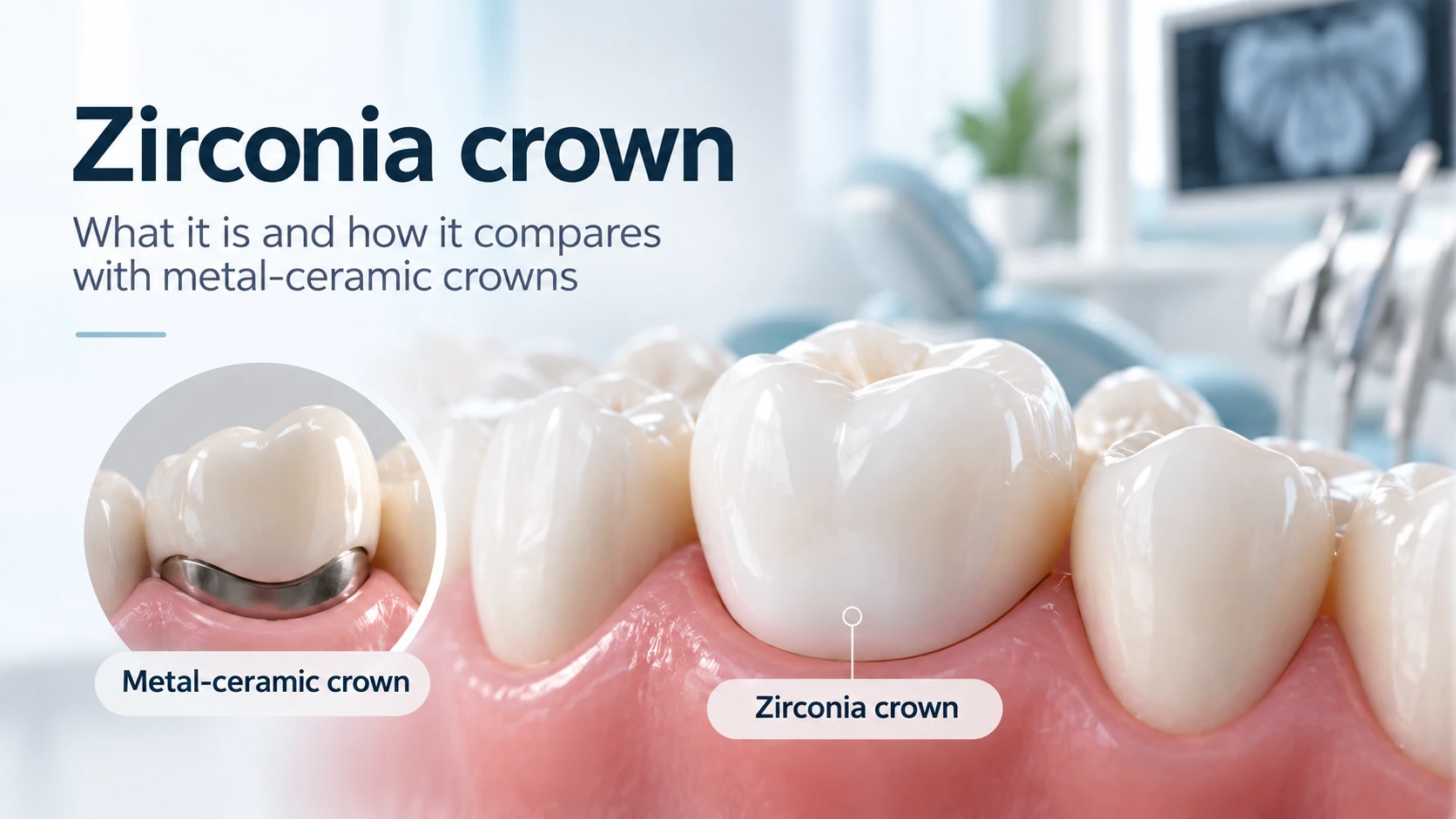
A zirconia crown is made from zirconium dioxide, a strong dental ceramic. Unlike a metal-ceramic crown, it has no metal framework inside.
Zirconia crowns come in different designs. Some are made mainly from a solid block of zirconia; others have an additional porcelain layer to achieve a particular appearance. The choice depends on the clinical situation.
When might a dentist recommend one?
A crown may be considered for a tooth with extensive damage, a large filling, a fracture or significant wear, or when its shape and function need to be restored.
After root canal treatment, a crown is sometimes used to protect a weakened tooth. However, having root canal treatment does not automatically mean that every tooth needs a crown.
For a smaller defect, a more conservative restoration may preserve more of the natural tooth. The decision is made after an examination.
How are zirconia crowns made and fitted?
Treatment usually involves several stages.
Examination and planning
The dentist assesses the tooth, gums and bite. An X-ray and preliminary treatment may be needed.
Before a crown is fitted, the tooth and surrounding tissues need to be in a condition that allows it to be placed securely.
Preparing the tooth
The tooth is shaped to accommodate the crown. Local anaesthetic is used when needed.
The dentist then takes an impression or a digital scan. This information is used to make the custom restoration. A temporary crown may be fitted while the permanent one is being made.
Making the crown
A dental laboratory uses the information provided to make a crown in the required shape and shade.
Material selection takes into account more than appearance: the tooth's position, chewing forces, bite and amount of remaining tooth structure also matter.
Checking the fit and securing the crown
Before final placement, the dentist checks the crown's fit, shape, colour and contacts with the neighbouring and opposing teeth.
After any necessary adjustments, the crown is secured with an appropriate dental material.
Main advantages of zirconia crowns
Zirconia crowns have no metal framework. This means they do not develop the visible metal band at the edge that can sometimes be seen with metal-ceramic crowns.
Modern types of zirconia can provide a natural tooth shade. The material is also strong and can be used in different parts of the mouth.
Clinical research reports high survival rates for modern zirconia single crowns, comparable with those of metal-ceramic crowns. However, no material is indestructible, and the lifespan of an individual crown cannot be guaranteed in advance.
Zirconia or metal-ceramic: what is the difference?
| Feature | Zirconia crown | Metal-ceramic crown |
|---|---|---|
| Core material | Zirconium dioxide | Metal framework |
| Metal | No metal framework | Contains a metal framework |
| Appearance | Can provide a natural tooth shade; the result depends on the type of zirconia and crown design | Porcelain is matched to the teeth, but the metal core limits translucency |
| Gumline margin | No metal edge | A dark edge may become visible over time in some cases |
| Strength | High | High |
| Possible problems | Chipping or damage, loosening of the cement bond, problems with the underlying tooth | Porcelain chipping, loosening of the cement bond, problems with the underlying tooth |
| Choice | Depends on the clinical situation | Depends on the clinical situation |
Neither material is automatically the best choice for every patient. Modern studies show good results for both zirconia and metal-ceramic single crowns. The choice depends on the tooth, aesthetic needs, bite, chewing forces and other factors.
Read more about the alternative in our article Metal-ceramic crowns: materials, fitting and care.
Limitations and things to consider
Fitting a crown requires preparation of the tooth and removal of some tooth structure. This part of treatment is irreversible.
Even a strong zirconia crown can be damaged. Other possible problems include loosening of the cement bond, changes in how the teeth meet, or problems with the underlying tooth.
A crown does not make a tooth immune to decay. Decay can develop around the crown's edge if plaque builds up there.
Heavy grinding or clenching increases the load on the restoration. Your dentist may discuss additional protective measures in this situation.
How to care for a zirconia crown
A crowned tooth needs the same regular oral hygiene as your natural teeth.
Brush twice a day with fluoride toothpaste and clean between your teeth every day with floss or suitable interdental cleaning aids.
Do not use your teeth to bite very hard objects. Regular dental examinations help monitor the crown, its edges, the surrounding gums and the tooth itself.
When to see your dentist
Arrange a review if the crown becomes loose, chips or cracks, interferes with your bite, or if you develop pain, swelling or significant discomfort around the restored tooth.
Do not try to glue a fallen-out crown back in place yourself.
Price at Dental Clinic Kapital 2022
Metal-free ceramic (zirconia) — 35,000 AMD
The price is for one crown. Any preliminary treatment, the condition of the tooth, preparation for the crown and the overall scope of treatment are assessed after an examination.
Need advice or an appointment?
Appointments every day, 09:00–23:30.
Sources
- American Dental Association, MouthHealthy — Crowns
- Cleveland Clinic — Dental Crowns: Types, Procedure & Care
- Pjetursson BE et al. (2026). Tooth-supported single crowns: systematic review and meta-analysis, Part 1. International Journal of Prosthodontics. DOI: 10.11607/ijp.9633.
- Laumbacher H et al. (2021). Long-term clinical performance and complications of zirconia-based restorations: a summary of systematic reviews. Journal of Dentistry. DOI: 10.1016/j.jdent.2021.103723.