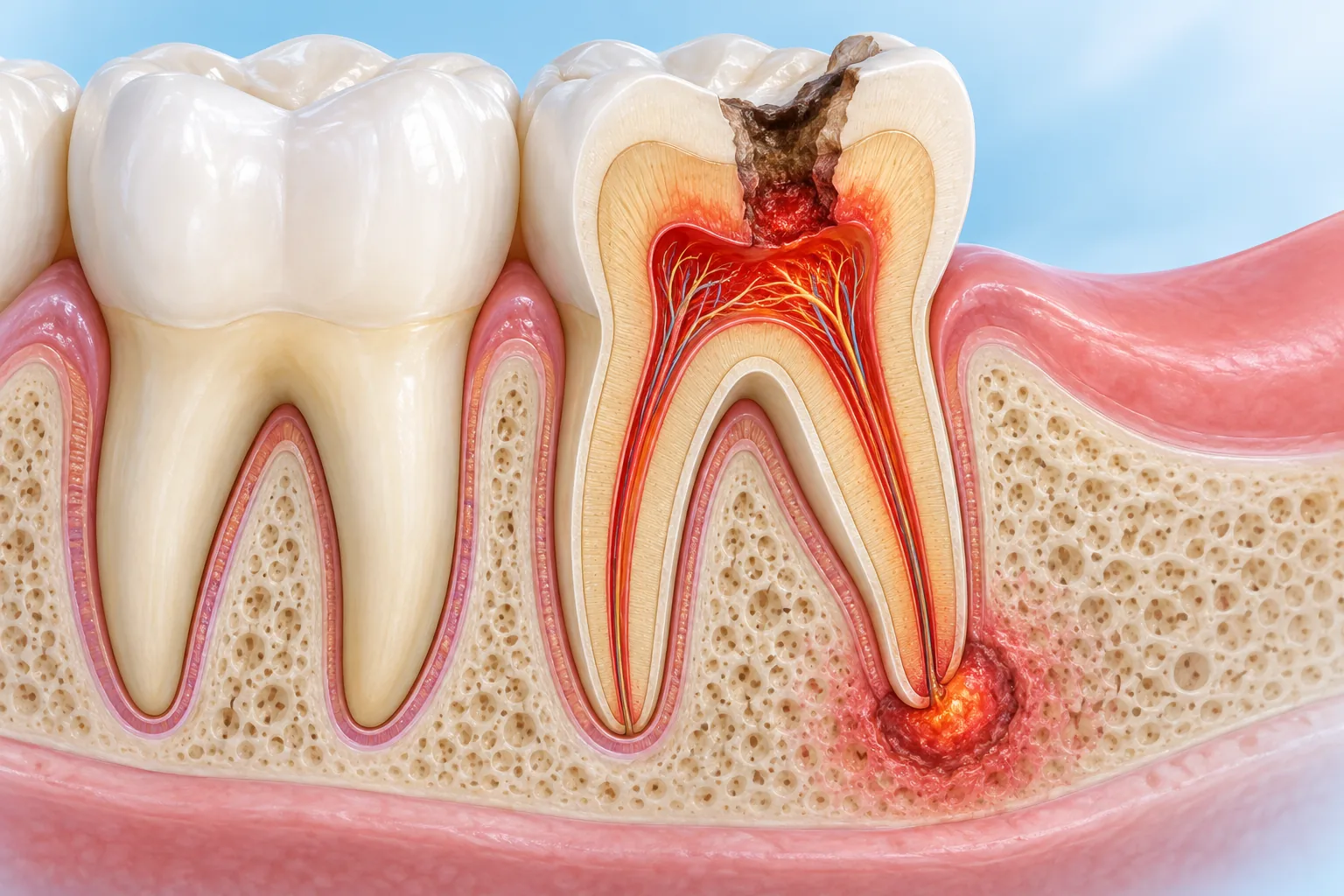
What happens inside the tooth?
Deep decay, a crack, injury or repeated dental procedures can irritate or infect the pulp, the tissue containing nerves and blood vessels inside the tooth. If the pulp cannot recover or dies, infection may reach the tissues around the root tip.
The word “periodontitis” is used for different conditions. This article concerns apical periodontitis at the tooth root, not chronic gum disease.
Symptoms that need assessment
Lingering pain after hot or cold, spontaneous or night pain, pain when chewing, a darkening tooth, swelling or a recurring spot on the gum should be assessed promptly. Sometimes a change is found on an X-ray without pain.
Rapidly increasing facial swelling, fever, or difficulty swallowing or breathing requires urgent medical attention.
How is it diagnosed?
The dentist examines the tooth and gum, checks decay and restorations, and tests the response to cold, tapping and biting. An X-ray is usually required.
No single symptom is enough. The diagnosis is based on the history, examination, tests and imaging together.
Main treatment steps
If irritation is early and reversible, removing the cause and restoring the tooth may be enough. Irreversible inflammation, dead pulp or infected canals may require root canal treatment.
After local anaesthetic, the tooth is isolated. Inflamed or infected tissue is removed, and the canals are cleaned, shaped and filled. The tooth is then restored with a filling or another suitable restoration.
What determines the amount of treatment?
Factors include the diagnosis, canal number and anatomy, spread of infection, loss of tooth structure, previous treatment and whether the tooth can be restored. More than one visit may be needed.
Antibiotics do not replace treatment of the source in the tooth and are prescribed only when medically indicated.
What may be felt afterwards and how to care
Mild tenderness on biting can occur for a few days. Until the final restoration is complete, avoid hard chewing on the tooth and follow the instructions for your case.
Continue normal oral hygiene. Contact the clinic for severe or increasing pain, swelling, fever, loss of a temporary filling or a bite that feels wrong.
Follow-up
Follow-up may include an examination and, when indicated, another X-ray to assess changes around the root over time. Neither a treatment result nor the lifespan of the tooth can be guaranteed in advance.
Frequently asked questions
Does pulpitis always cause severe pain?
No. Symptoms vary with the stage, and pain can sometimes decrease after the pulp dies even though infection remains.
Can I wait if the pain has stopped?
Pain stopping does not necessarily mean the tooth has healed. A tooth that previously caused significant pain should be assessed.
Is root canal treatment always needed?
No. Treatment depends on the exact diagnosis and whether the pulp can recover.
This material is for general information. A dentist determines the diagnosis and final treatment plan after an examination and discussion of the available options.
Sources
Local anaesthesia may be used at the dentist’s discretion, depending on the procedure and health history. The clinic also uses the DENCO E-MATE AI electronic injector. Electronic dental anaesthesia
Need advice or an appointment?
Appointments every day, 09:00–23:30.