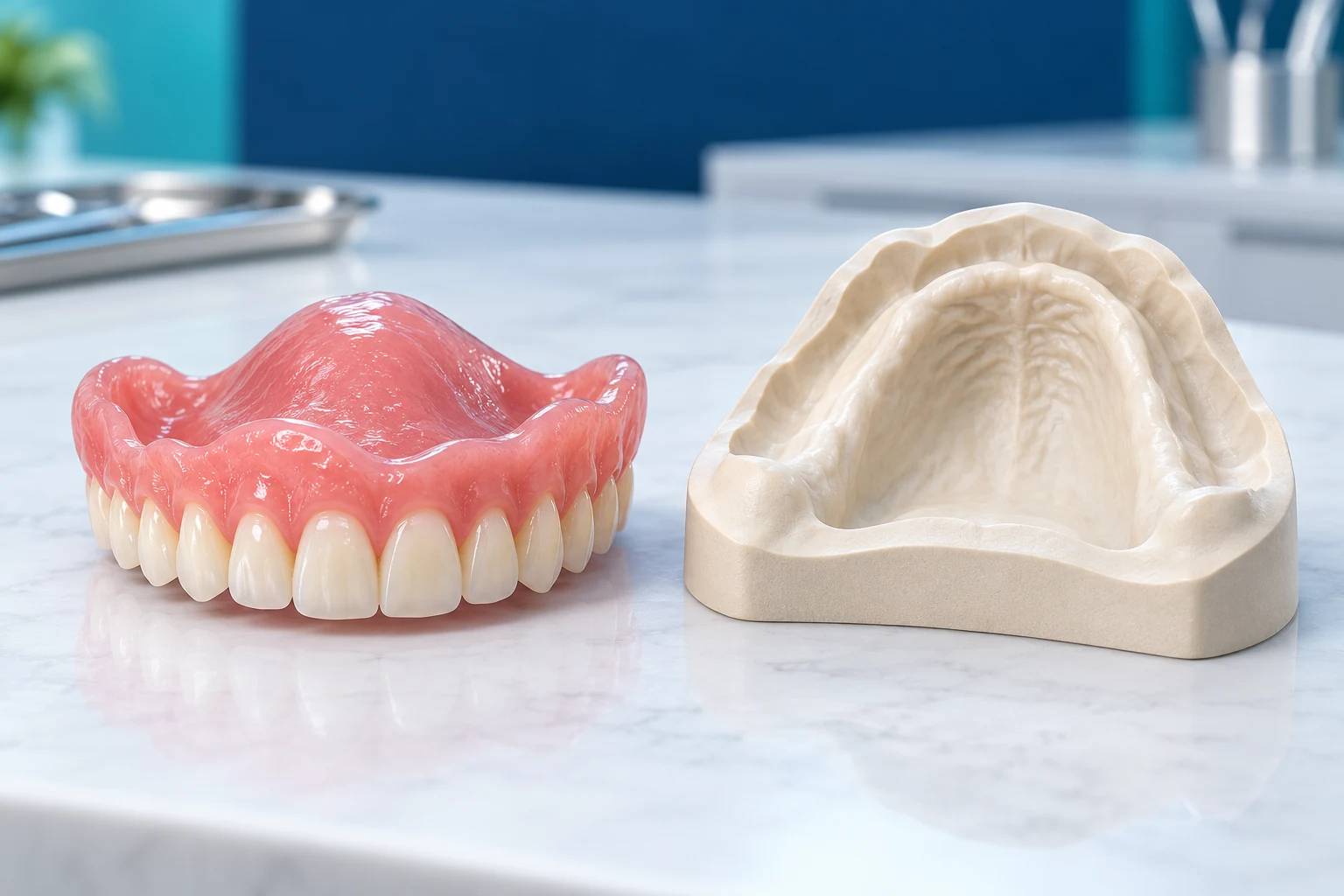
What is a removable denture?
It is an appliance you can take out yourself for cleaning. A complete denture replaces all the teeth in one jaw; a partial denture replaces missing teeth alongside remaining natural teeth. The choice requires an examination, not simply counting missing teeth or looking at a photograph.
This article concerns an acrylic removable denture for one jaw. Flexible, cast partial, temporary and fixed prostheses differ in design and indications. The materials described here should not be assumed to apply to all those options.
When might an acrylic denture be considered?
It may be considered for complete or partial tooth loss when a removable appliance suits the condition of the mouth, functional needs and the patient's circumstances. It can help with chewing, speech and appearance, although the improvement varies.
Inflamed tissues, problems with remaining teeth or inadequate hygiene may require attention first. The supporting tissues, ridge shape, saliva and ability to clean the appliance affect the choice. Tell your dentist about previous reactions to dental materials. Acrylic dentures are not suitable for everyone.
The parts of an acrylic denture
The base is the supporting part, usually pink, that fits against the denture-bearing tissues and holds the artificial teeth. Its shape and borders must accommodate the anatomy and distribution of chewing forces. Artificial teeth form the dental arch and contribute to chewing, speech and appearance.
A partial denture may include clasps and other retaining or supporting elements. Their position depends on the remaining teeth. A complete denture is retained differently: fit, anatomy and muscle activity all influence its stability.
Vertex Rapid Simplified base material: the Netherlands
Vertex Rapid Simplified is a heat-cured acrylic denture base material from Vertex Dental in the Netherlands. The manufacturer specifies its use for complete and partial denture bases made by the pressing technique, with several shades including pink and translucent options.
Heat curing gives the material its final structure in the laboratory. The manufacturer provides rapid and extended curing options under its instructions. A curing cycle is only one stage; it is not the time needed to make a finished denture.
“Cadmium-free” describes composition, not a guarantee that allergies cannot occur. Correct curing, finishing and polishing are important. Laboratory strength figures cannot guarantee that a denture will not break after a fall, excessive loading or changes in fit.
Ruthinium Acry Rock V artificial teeth: Italy
Ruthinium Acry Rock V is manufactured by Dental Manufacturing S.p.A., Italy. These acrylic teeth are made from polymethyl methacrylate (PMMA) with two colour layers. The layers help create a natural-looking appearance, but do not guarantee the same aesthetic result for every patient.
The manufacturer lists 19 shades and different shapes and sizes of anterior and posterior teeth. Selection uses the corresponding Acry Rock V shade guide alongside the remaining teeth, facial proportions, smile and patient preferences. The number of shades in this range should not be equated with the number of designations in another shade system.
The range includes anterior and posterior sets and sets of 28 teeth. Packaging does not determine how many teeth an individual denture needs. Tooth position, bite, tissue condition and jaw anatomy also affect appearance and function. Artificial teeth can wear or become damaged.
How the denture is selected
The dentist assesses remaining teeth, oral tissues, jaw shape, bite, existing dentures and hygiene. Further investigations are arranged when indicated. The discussion covers likely stability, the size of the base, appearance, expectations and alternatives. A price list alone cannot establish the appropriate material or design.
Stages of manufacture
- Consultation, examination and assessment of any preparatory treatment.
- Selection of the design and agreement on a plan.
- Impressions; a digital method may be used if available and suitable for the chosen workflow.
- Recording the jaw relationship, bite and requirements for artificial teeth.
- Laboratory preparation and tooth arrangement, with an intermediate try-in where appropriate.
- Final manufacture, finishing and polishing of the base.
- Fitting: checking adaptation, retention, tooth contacts and comfort.
- Care instructions, follow-up and adjustments when necessary.
The sequence and extent vary with the clinical situation. Appointment numbers and completion times are agreed individually, not promised uniformly.
Benefits and limitations
An acrylic appliance can replace several teeth or a whole arch, is individually designed and can be removed for cleaning. Repair or adjustment may be possible, subject to assessment.
It can feel bulky, require adaptation and be less stable than other options in some situations. Rubbing, tooth wear and base fractures are possible. Tissue changes can alter the fit. Longevity depends on design, laboratory work, anatomy, loading, hygiene and follow-up; a fixed lifespan cannot be guaranteed.
Getting used to a denture
An unfamiliar feeling, changes in saliva, pronunciation and chewing may occur initially. Gentle speech practice and gradually trying small pieces of softer food can help, following the dentist's advice. Adaptation time varies.
Severe or increasing pain, sores, bleeding and marked instability require review rather than simply persevering. Do not file the denture or bend its retaining elements yourself.
Cleaning and storage
Clean every surface daily with a soft brush and a compatible non-abrasive product recommended by your dentist. Remove food debris and rinse after meals. Ordinary abrasive toothpaste can scratch acrylic. Use soaking products according to their instructions and check compatibility with any metal components. Rinse thoroughly afterwards.
Clean remaining teeth separately with fluoride toothpaste and gently clean the tongue and oral tissues. Handle the denture over a soft towel or a basin of water to reduce the risk of breakage if dropped.
Dentures are usually removed at night unless the dentist advises otherwise. Confirm storage instructions for your appliance: protect acrylic from drying out, using a clean container and recommended water or compatible solution. Avoid hot water, harsh household chemicals and household glue. Regular dental reviews remain important even without natural teeth.
When to see the dentist
Arrange a review for rubbing, pain, reduced retention, altered fit or difficulty chewing. A cracked base or a damaged or detached tooth also needs assessment. Do not wear a denture with sharp or loose fragments; keep the pieces and bring them to the dentist. Do not attempt home repairs.
Price for one jaw
At Dental Clinic Kapital 2022, the “Removable denture for one jaw” service costs 45,000 AMD per jaw. This does not mean all possible preparatory procedures are included. The individual plan and any treatment of remaining teeth or other preparation are determined after examination.
Frequently asked questions
How do complete and partial dentures differ?
A complete denture replaces all teeth in one jaw; a partial replaces missing teeth while some natural teeth remain.
What is an acrylic base?
It is the supporting plastic part that fits against oral tissues and holds the artificial teeth.
Which materials does the clinic use?
For the acrylic constructions described here: Vertex Rapid Simplified for the base and Ruthinium Acry Rock V for the artificial teeth. The individual design is agreed after examination.
Can I choose the tooth shade?
Yes. Shade is selected together with shape, size and arrangement; a shade guide alone cannot show the finished smile.
How long does adaptation take?
There is no single timetable. Increasing pain or sores need examination rather than waiting for adaptation to finish.
What if the denture rubs?
Arrange an assessment and adjustment. Do not file the base yourself.
How should I care for it?
Clean it daily with compatible products, handle it carefully and follow individual advice on overnight removal and storage.
When is adjustment or replacement needed?
When fit, retention or chewing deteriorates, or wear or damage occurs. The dentist determines whether adjustment, repair or replacement is appropriate.
Related information and prices
This material is for general information. The final treatment and restoration option is determined by the dentist after an examination.
Sources
Need advice or an appointment?
Appointments every day, 09:00–23:30.